
Washing Doilies by Hand
- Academy St. Thrift
- Jan 24
- 2 min read

Updated: Jan 27

I was washing doilies by hand tonight.
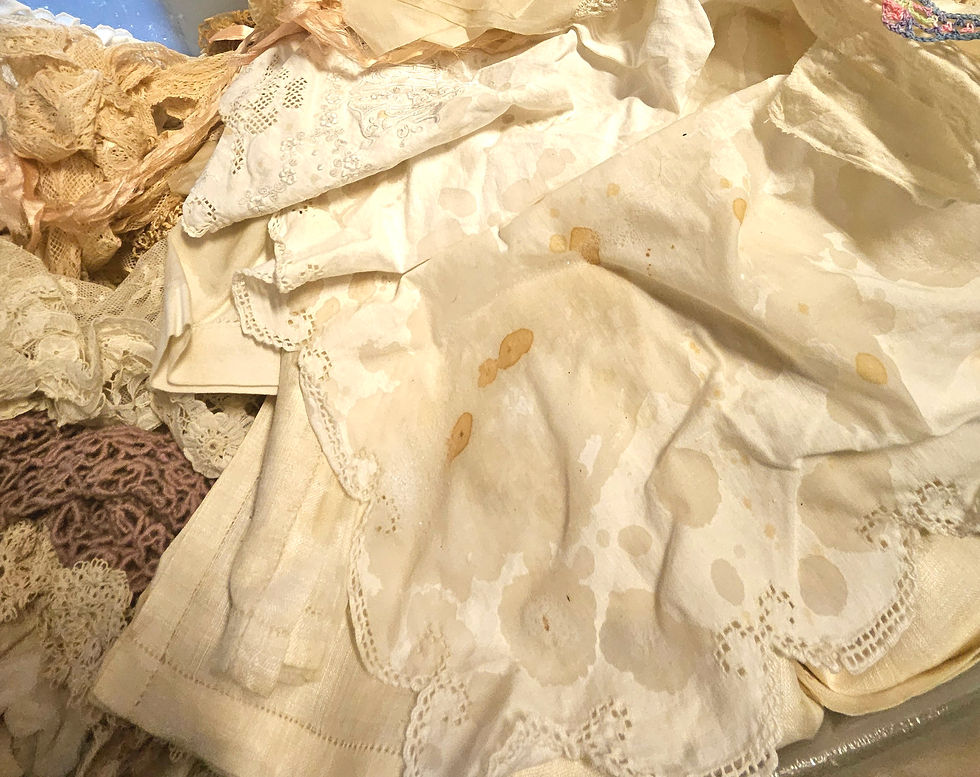
I had purchased a large container of them a while back, about twenty-five pounds worth. Hundreds, maybe thousands. I wasn’t in a rush. I stood at my sink, moving through them one by one, letting the work be slow and repetitive.
Each piece had been made by a different hand. Different women. Different homes. Different lives. As I washed them, I started noticing the same stain appearing again and again. Blood. Not once. Not occasionally. Consistently.
It wasn’t shocking in the way people expect that word to mean. It was grounding. I became aware of their labor, their skill, the intricate patterns they wove. The care it took to make something so delicate. And the fact that traces of them remained. All of it in my bathroom, being washed by me. By hand.
Standing there, it felt less like cleaning objects and more like holding evidence of work that had been done quietly, repeatedly, and without recognition. Not just the time spent weaving, but the living that happened alongside it. The doilies weren’t abstract. They had been used. Washed. Handled. Worn down. Passed through hands before they ever reached mine.
Pause.
Doilies weren’t made recently. Most of the ones we encounter now were produced decades ago, many of them between the late 19th century and the mid-20th century. They were made in homes, often by women, often by hand. Crochet hooks, thread, hours of repetition. Work done alongside cooking, cleaning, caregiving, factory shifts, farm labor. Work that was considered domestic, decorative, and therefore invisible.
So the question isn’t really when they were made. It’s under what conditions.
Why was there so much blood?
Not a single stain. Not an accident. But a pattern that repeated itself across hundreds of pieces. Blood that had been washed, faded, absorbed into thread, and still remained. Blood that wasn’t dramatic or catastrophic. Blood that looked like the residue of everyday life.
If you step back and think about the larger data set, the answer becomes less mysterious. The hands most likely responsible for this work were women’s hands. Working hands. Hands that labored through menstruation, injury, arthritis, childbirth, exhaustion. Hands that didn’t stop when bodies asked them to. Hands that kept going because stopping wasn’t an option.
These doilies weren’t made in studios. They were made in kitchens. At tables. On laps. Late at night. Early in the morning. In between everything else that had to be done. The blood doesn’t feel incidental. It feels structural.
And that’s the part that’s difficult to ignore once you see it. Because when we talk about vintage linens, or heirloom textiles, or “delicate” handiwork, we usually talk about beauty and skill. We talk about pattern and preservation. We don’t talk about the physical cost of that beauty. We don’t talk about what it required of the bodies that made it.
Standing there, washing them, I realized I wasn’t just handling objects. I was encountering evidence of labor that had been normalized, expected, and unrecorded. The blood wasn’t a flaw. It was a record.
What remains isn’t just thread and pattern.
It’s also biological proof of who carried the work.
I think that's amazing.


Comments